Market.iO: Mapping Markets with Clarity (Part 2)
This article is co-written with Tuan Huynh.
We’ll explore the Market.iO framework (originally published in Japanese) developed by Shun Sagara and use it to examine various aspects of the Indonesian and Vietnamese markets.
. . .
Now that we’ve outlined the Market.iO framework (see Part 1 here) and its key classifications, let’s dive deeper into each market type. By understanding the dynamics of different market structures — whether wide or narrow, competitive or uncontested, fast-moving or slow — you can refine your strategic approach. In this section, we’ll break down each market type, explore their implications, and highlight critical factors that drive success in different conditions.
A) WIDE-MANY-FAST
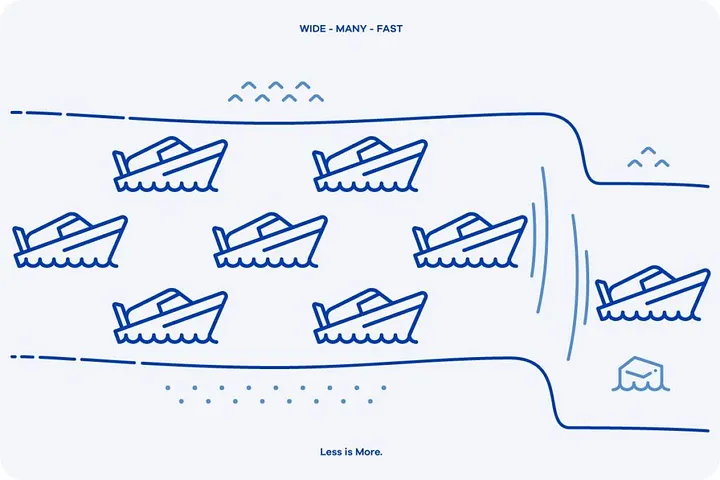
This market type is the most prevalent for startups poised to launch into competitive waters within a short timeframe. When evaluating investment opportunities in this space, we focus on several key considerations:
- What key factors drive rapid market adoption (a fast-flowing river)?
- Will this product replace existing solutions or coexist with them?
In the case of replacement:
- Taking into account users’ investments in existing products (e.g., inertia, community, data, and the effort required to migrate), is there a compelling value proposition or pivotal feature that can drive replacement?
- What is the replacement cycle? Can it happen at any time, or are there specific windows of opportunity (periodic or irregular)?
In the case of coexistence:
- Do users have the budget or resource to support the concurrent use of multiple products?
- In the event of an economic downturn or other triggers that cause competition for market share, would your company be more likely to retain customers compared to competitors? If so, why?
B) WIDE-FEW-FAST
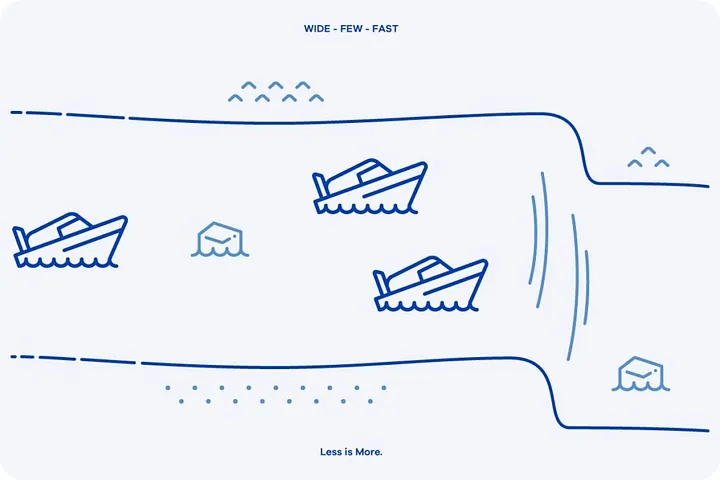
This market type is rare and promising, as it’s unusual to find few competitors in a large market. Unlike type A, it presents a unique opportunity, and we will examine the following key points:
- Why are there so few competitors in such a wide market?
- What factors drive the rapid user acceptance (fast flow of the river)? Are there any hidden challenges or obstacles (unseen rocks beneath the water surface)?
C) WIDE-MANY-SLOW
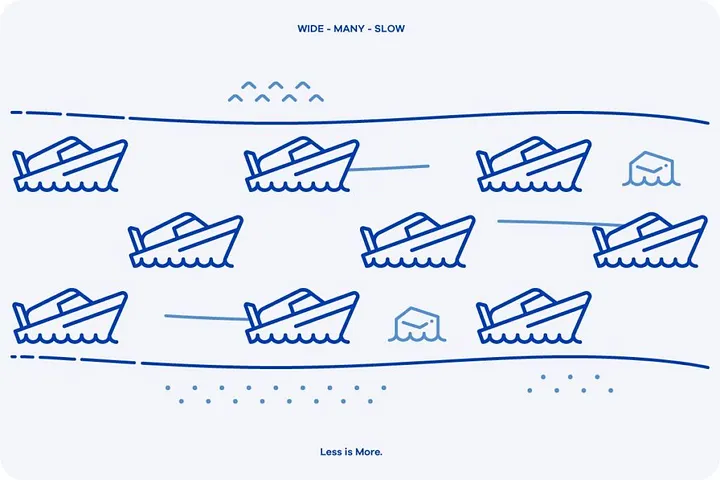
This market type suggests a previously thriving market that has now plateaued. For this type, we’ll explore the following points:
- What structural change could reignite the market’s growth?
- Is there potential for new market segments (tributaries) to emerge, even if the main market remains stagnant? If so, what factors might create these new segments, and are they robust and sustainable?
D) WIDE-FEW-SLOW
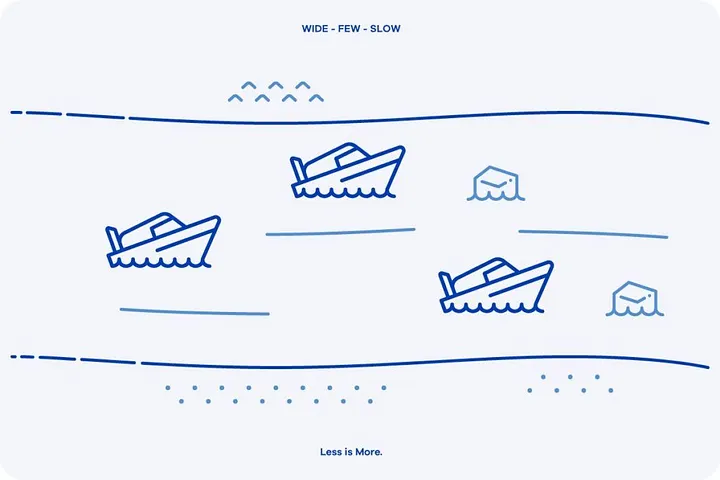
This market type is characterized by high barriers to entry, significant capital requirements, and challenges for startup penetration. When evaluating opportunities in this space, we focus on two key considerations:
- Is there potential to strategically carve out a niche within the “luxury cruise ship” market dominated by leading or oligopolistic players? Are these established players facing an innovator’s dilemma?
- To what extent can we navigate or influence the underlying “bedrock” (i.e., the legal and regulatory framework)?
E) NARROW-FEW-FAST
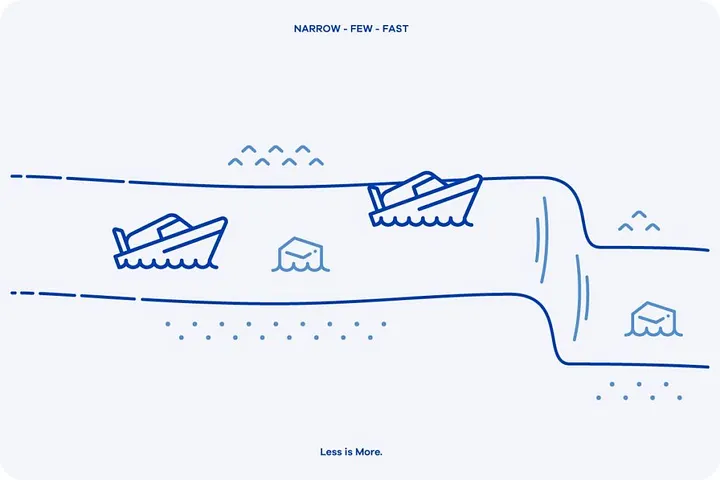
This market type is small but has a strong current, with the potential to navigate through obstacles and merge into a larger market. It represents the early stages of entrepreneurship and market development, and we’ll focus on the following points:
- What factors drive the market’s rapid growth?
- If there is a pivotal moment that significantly expands the market, when might it occur and what would trigger it?
- What sustainable barriers, if any, can be established to defend against future competitors?
F) NARROW-MANY-FAST
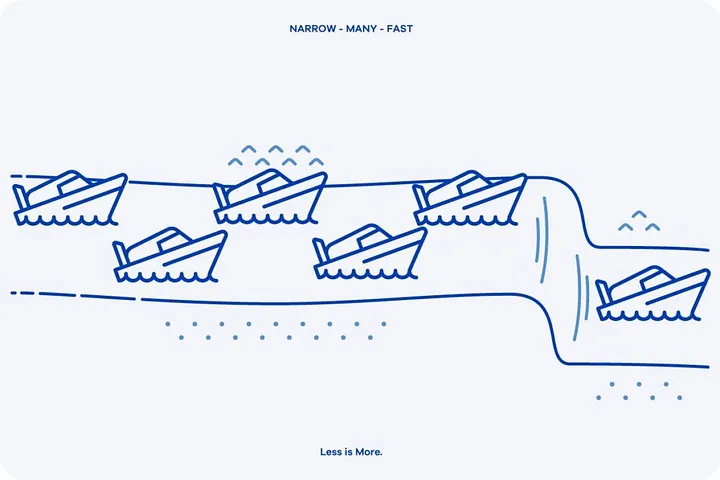
This type is similar to type E (NARROW-FEW-FAST), combined with some elements of type A (WIDE-MANY-FAST).
This market type is characterized by rapid growth, often fueled by hype surrounding a novel business model. Such models can quickly gain traction, attracting both entrepreneurs and investors in a short span of time.
It has similar considerations to type E with regards to factors driving market growth, tailwinds, and creating barriers to entry. However it has one key difference that lends from considerations of type A:
- Will this new offering replace a portion of users’ existing financial commitments (wallet share), or will it coexist alongside current solutions?
Realistically, a business in this market type is unlikely to be sustainable long-term. To achieve sustainability, the market must either expand from NARROW to WIDE in the short to mid-term, or the company must successfully replace existing solutions or outperform competitors to consolidate the market, shifting it from MANY to FEW.
G) NARROW-FEW-SLOW
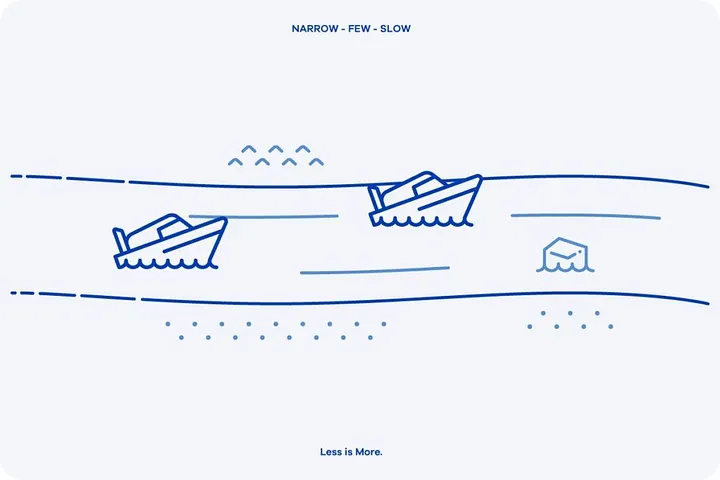
This market type is characterized by a narrow river with few boats and a slow current. The targeted market sub-segment consistently generates sales between $100K and $100M but isn’t expected to reach annual market sales of $3B within the next 7 to 10 years. It’s well-suited for small and medium businesses that don’t seek venture capital funding. The evaluation process mirrors that of type E — if the answers to the key questions are consistently negative, the market falls into type G.
H) NARROW-MANY-SLOW
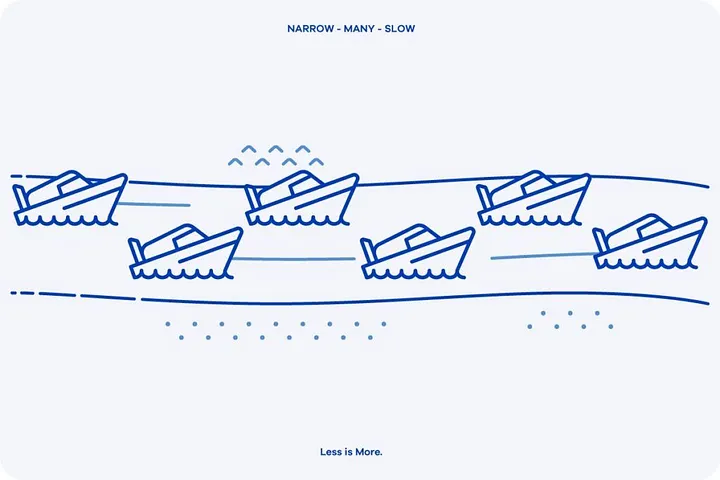
Like type G (NARROW-FEW-SLOW), this market is best suited for small businesses. It emerges when the arguments for type F consistently yield negative results. While we can theoretically derive this market type from the combination of the three categories, it’s extremely rare to encounter in real-world scenarios. The likelihood of finding such a market is minuscule.
. . .
Market dynamics are ever-evolving, and the Market.iO framework provides a structured way to assess opportunities and challenges with clarity. By identifying where a market stands — its size, competition, and adoption speed — you can make more informed strategic decisions. As we continue exploring market insights, we’ll dive deeper into how businesses can adapt their approach to navigate different market conditions successfully. Stay tuned for more insights on applying Market.iO in real-world scenarios.