Market.iO: Mapping Markets with Clarity (Part 1)
This article is co-written with Tuan Huynh.
We’ll explore the Market.iO framework (originally published in Japanese) developed by Shun Sagara and use it to examine various aspects of the Indonesian and Vietnamese markets.
. . .
Let’s explore the concept of Market.iO, a framework that allows us to grasp an otherwise intangible “market” and quickly assess market potential from a multidimensional yet insightful perspective. It’s a tool that sharpens our understanding of market dynamics, opportunities, and the ideal timing for market entry. This framework enables us (as investors) and founders to focus their limited time on meaningful discussions about truly impactful businesses.
We analyze the market using three key categories, employing a metaphor of a river and boats to illustrate these concepts. This approach identifies eight distinct market types, each resulting from different combinations of these three categories:
- Width of river: Is it WIDE or NARROW?
- Number of ships: Are there MANY or FEW?
- Speed of flow: Is it FAST or SLOW?
Once you select one of these eight types, the system offers key considerations for each scenario. While there’s room for refinement in how we determine each category, we’ve established the following simplified criteria for now:
- Width of river (Market Size): We currently define a WIDE market (can be a sub-segment) as one with a size exceeding $3 billion, while smaller markets are considered NARROW.
- Number of ships (Competitors): We define MANY as 10 or more competitors in the domestic market, or 100+ globally, while anything fewer is considered FEW.
- Speed of flow (Speed of adoption): This indicator is more challenging to measure precisely, so we use a more qualitative approach. We’re essentially assessing how quickly customers are adopting services in this market segment.
In subsequent articles, we’ll focus primarily on Indonesia and Vietnam to demonstrate how this framework can provide a quick market overview and lead us to valuable insights through a set of critical questions.
WIDE or NARROW
While the financial sector in both Indonesia and Vietnam is undoubtedly a WIDE market, this broad categorization isn’t particularly useful when evaluating specific business models within the industry. Various factors must be considered, including the market size of sub-sectors, the target market, and market accessibility.
When evaluating a company’s potential customer base, it’s crucial to initially focus on the core target segment while keeping long-term expansion in mind. This approach clarifies the market’s true potential from the outset. Target segments can range from the mass market and affluent individuals to high-net-worth individuals (HNWIs) and ultra-high-net-worth individuals (UHNWIs). Each segment’s behavior — including digital savviness and willingness to pay — varies significantly, directly impacting revenue potential.
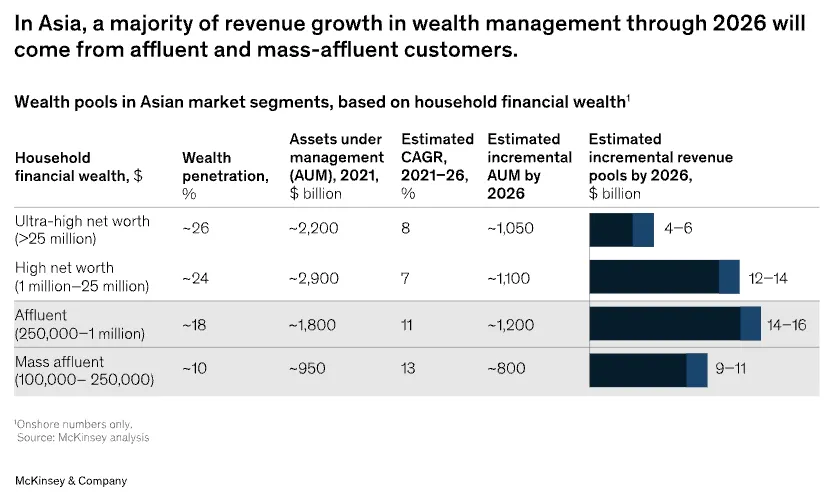
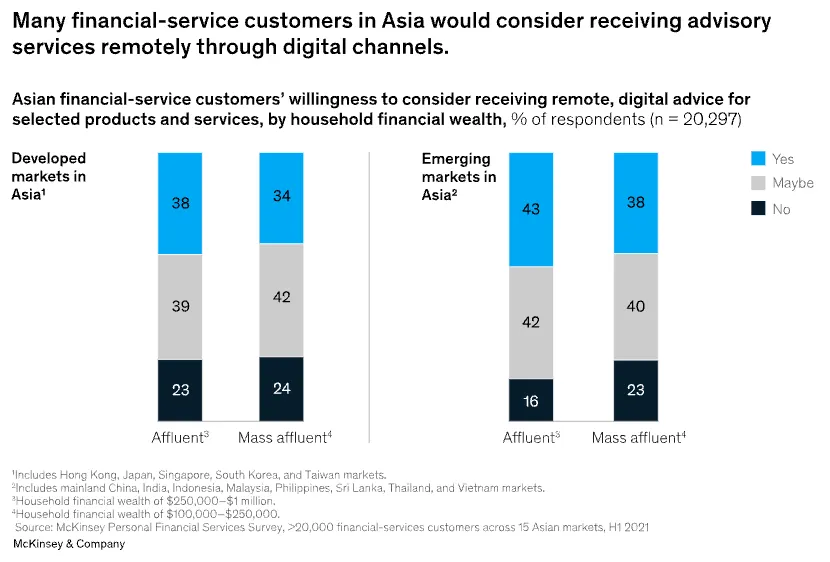
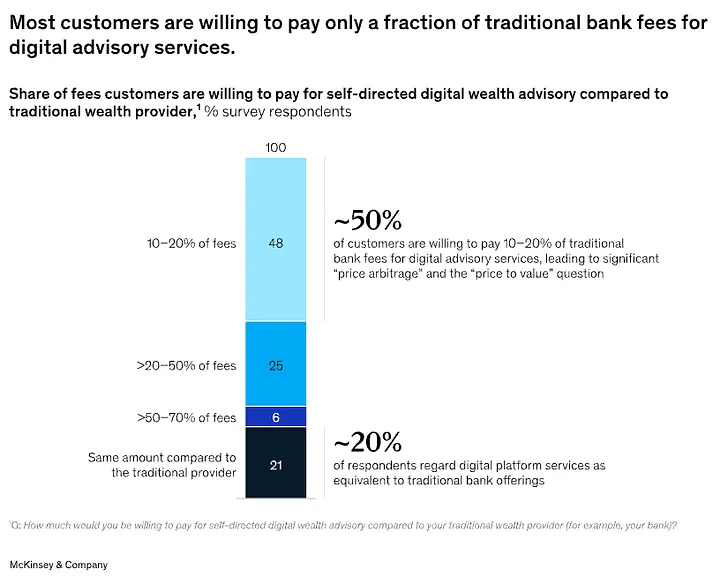
Drawing from McKinsey’s analysis of digital wealth and Personal Financial Assets (PFA) in Asia-Pacific, we observe that the affluent and mass affluent segments, despite their relatively low wealth penetration and Assets Under Management (AUM), are projected to grow the most in the next two years. As individuals from the mass, affluent, and HNWI segments accumulate more wealth and become increasingly tech-savvy, they’re likely to embrace fintech and wealthtech solutions. However, a closer look reveals a significant caveat: most of these users are only willing to pay between 10–50% of the fees charged by traditional providers.
Considering these insights and combining them with the TAM, SAM, SOM framework, we can make informed estimates about revenue potential and gain a more precise understanding of the true market size.
MANY or FEW
While many companies operate in the financial sector, not all are competitors. Building on our previous example of identifying target market segments, we must consider each group’s preferred asset classes. A competitor analysis should encompass both direct and indirect players, including tech and traditional companies. In essence, a competitor is any alternative that could divert funds a potential user might have invested in your platform.
For instance, if a company targets HNWIs, we should identify players currently managing these clients’ assets. This includes banks, insurance companies, asset management firms, securities companies, crypto exchanges, private investment firms, and even real estate brokerages. We can further categorize these based on risk profiles, depending on the business model. On the other hand, if a company targets the mass market, it might compete for funds typically allocated to daily necessities or discretionary spending. This scenario requires a different approach to encourage users to invest.
FAST or SLOW
This is a tricky one and can be quite subjective. To help us identify the right type, we can rely on some guiding questions:
- Market gap: What adoption barriers exist? If you could address these issues, what evidence suggests your target market would embrace your services?
- Demand growth: What key drivers have motivated the chosen customer segment to adopt investment platforms and services? Are there market tailwinds or other factors suggesting that this demand will persist and grow over time?
Now that we’ve explored the three key categories of the Market.iO framework, take a moment to reflect on your business:
- Is your market WIDE or NARROW? Consider the potential market size and your initial target segment.
- Are there MANY or FEW competitors in your space? Remember to include both direct and indirect players.
- Is the market adoption FAST or SLOW? Think about the factors driving demand and any potential barriers.
By answering these questions, you’ll be able to identify which of the eight market types best describes your situation. This insight can help shape your strategy and understand the unique challenges and opportunities you may face. Keep these classifications in mind as we delve into each market type in more detail in Part 2.